

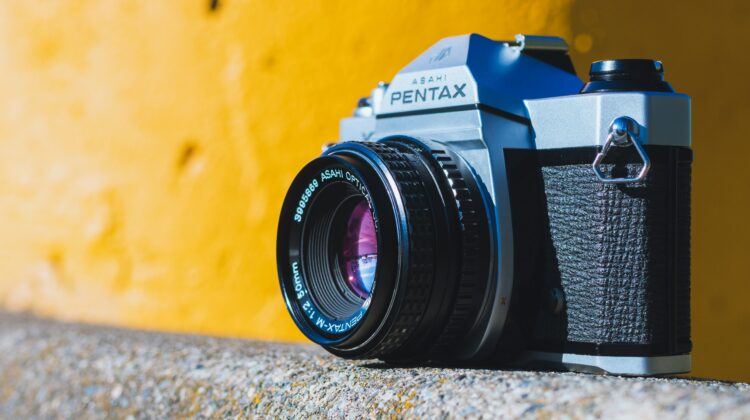
If there is one camera that has introduced more people to the art of traditional analog photography than any other, it is the legendary Pentax K1000. Originally launched in 1976 by Asahi Pentax, this stripped-down mechanical workhorse remained in continuous production for over 20 years until 1997, selling over three million units worldwide.
For decades, art schools, photography teachers, and university professors mandated the K1000 as the standard learning tool for their students.
The reasoning was beautiful in its simplicity: it has no automatic modes, no computer screens, and zero electronic safety nets. It forces you to actually learn the relationship between light, shutter speed, and aperture. In this full Pentax K1000 review, we will break down its technical specifications, its legendary tank-like build quality, its top lens compatibility, and why it is the ultimate purist camera to buy today.


Specifications
- • Brand: Pentax
- • Batteries: 1 Lithium-ion battery is required. (included)
- • Compatible Mountings: Pentax K
- • Aspect Ratio: 3:2
- • Photo Sensor Technology: Analog Film Camera
- • Supported File Format: RAW
- • Image Stabilization: Analog Film Camera
- • Maximum Focal Length: 50 Millimeters
- • Optical Zoom: 1 x
- • Maximum Aperture: 2 Millimeters
- • Metering Description: Center Weighted
Technical Specifications: Absolute Mechanical Simplicity
The beauty of the Pentax K1000 lies in its lack of complex electronics. Let's look at what powers this mechanical beast:
- Camera Type: 35mm Single Lens Reflex (SLR)
- Lens Mount: Pentax K-Mount (Bayonet system)
- Shutter: Completely mechanical, rubberized silk focal-plane shutter
- Shutter Speeds: $1\text{s}$ to $1/1000\text{s}$ plus Bulb (B)
- Exposure Mode: Fully Manual (You control everything)
- Exposure Metering: TTL center-weighted needle meter (Requires battery)
- ISO Range: Manual selection from ISO 20 to 3200
- Power Source: One $1.5\text{V}$ LR44 or SR44 button-cell battery (Only for the light meter)
- Weight: $520\text{g}$ (Body only, without lens)
3 Reasons the Pentax K1000 is Completely Invincible
1. 100% Fully Mechanical Operation
The defining feature of the Pentax K1000 is that it does not need a battery to operate. The battery compartment inside the base plate strictly powers the small exposure needle in the viewfinder.
If your battery dies in freezing winter temperatures or during a remote mountain trek, the camera’s mechanical shutter functions perfectly across all speeds from 1 second up to $1/1000\text{s}$. You will never miss a shot due to a dead circuit board.
2. Indestructible "Tank-Like" Build Quality
The early versions of the K1000 (often distinguished by the "Asahi" branding on the pentaprism housing) are built almost entirely out of heavy brass plates and solid steel gears.
There are no delicate plastic internal components or flexible digital cables to degrade over time. It can take heavy bumps, accidental drops, and rugged travel environments, and it will keep firing accurately without losing alignment.
3. The Universal Pentax K-Mount Ecosystem
When you pick up a K1000, you gain instant compatibility with the massive Pentax K-mount system. This is one of the most widely adopted lens mounts in film history.
Not only can you use premium Pentax SMC (Super Multi Coated) glass, but you can also mount exceptional budget lenses made by Ricoh, Cosina, Vivitar, and Chinon without any structural adapters.
You May Also Like:
Looking for a classic 1981 electronic SLR with a highly automated Program mode instead? Check out our deep-dive Canon AE-1 Program Review: 5 Reasons It's the Best 35mm SLR.
Pure Manual vs. Electronic SLRs: Side-by-Side Comparison
Let us look at how the mechanical Pentax K1000 compares to the highly popular electronic options from Canon and Minolta:
| Camera Model | Shutter Control | Operation Without Battery | Viewfinder Meter Style |
|---|---|---|---|
| Pentax K1000 | Fully Mechanical | Yes (All speeds work perfectly) | Classic Moving Analog Needle (+ / -) |
| Canon AE-1 Program | Electronic | No (Shutter locks completely dead) | Digital LED Aperture Values |
| Minolta X-700 | Electronic | No (Requires voltage to release mirror) | Vertical LED Shutter Speed Bars |
How to Read the K1000 Needle Light Meter?
Looking inside the Pentax K1000 viewfinder is like stepping back in time. On the right-hand side, you will find a simple mechanical needle alongside a plus sign (+) at the top and a minus sign (-) at the bottom.
- If the needle points directly to the center index mark, your shot is perfectly exposed.
- If the needle hovers high near the (+), your image is overexposed. Turn your lens aperture ring to a higher f-number or speed up your shutter dial.
- If the needle drops down near the (-), your image will be too dark. Open up your aperture or slow down your shutter speed.
You May Also Like:
Want to look at an ultra-bright Acute Matte viewfinder option? Read our complete Minolta X-700 Review: 5 Reasons It's the Ultimate Vintage SLR.
Top 3 Lenses for the Pentax K1000 System
To unlock the razor-sharp rendering capabilities of this mechanical camera, track down these three highly rated K-mount options:
1. Pentax SMC 50mm f/2 (or f/1.4)
The $50\text{mm}$ $f/2$ is the classic kit lens that shipped with millions of K1000 bodies. It is incredibly cheap, highly resistant to optical flare, and performs with remarkable center sharpness. If you want ultra-creamy low-light backgrounds, upgrade to the slightly more expensive $f/1.4$ variant.
2. Pentax SMC 28mm f/2.8
The perfect companion lens for outdoor street exploration and expansive travel landscapes. It features minimal distortion, compact barrel architecture, and lets you capture clean environmental perspectives effortlessly.
3. SMC Pentax-M 135mm f/3.5
An outstanding telephoto portrait option. It offers exceptional subject isolation and compressed background bokeh, making it fantastic for outdoor studio portraits or candid street shooting from a comfortable distance.
Premium Mechanical Upgrades & Support Gear
Get your classic Pentax camera locked and loaded for intense field use with these highly compatible Amazon recommendations:
Complete Your Pentax K1000 Mechanical Setup
-
Energizer LR44 1.5V Alkaline Button Cells (10-Pack):
BEST VALUEStar Rating★★★★★4.9 out of 5 starsOur Score9.9/10Specifications
- • Brand: Energizer
- • Batteries: 1 Lithium-ion battery is required. (included)
- • Number of Batteries: 10 Nonstandard Battery batteries required.
- • Battery Cell Composition: Alkaline
- • Battery Capacity: 175 Milliamp Hours
- • Recommended Uses For Product: Watch
-
Ilford HP5 Plus 400 (35mm - 3 Pack Bundle):
EDITORS CHOICEStar Rating★★★★★4.9 out of 5 starsOur Score10/10Specifications
- • Brand: Ilford
- • Film Format Type: 135
- • Model Name: HP5 Plus
- • Film Color: Black and White
- • Batteries: 1 Lithium-ion battery is required. (included)
- • Exposures per Roll: 36
-
Kodak UltraMax 400 (35mm Roll):
TOP CHOICEStar Rating★★★★★4.8 out of 5 starsOur Score9.8/10Specifications
- • Brand: KODAK
- • Film Format Type: 135
- • Model Name: Ultramax 400
- • Film Color: Color
- • Batteries: 1 Lithium-ion battery is required. (included)
- • Exposures per Roll: 36
-
Vintage Padded Leather Camera Bag:
PREMIUM PICKStar Rating★★★★★4.7 out of 5 starsOur Score9.8/10Specifications
- • Batteries: 1 Lithium-ion battery is required. (included)
Q1: What is the difference between early Asahi Pentax K1000 models and later versions? +
Early models made in Japan feature the "Asahi" logo engraved on the pentaprism and are constructed with solid brass top and bottom plates. Later production models (shifted to Hong Kong and China) replaced the metal top plate with plastic polycarbonate components and omitted the Asahi logo, making them lighter but slightly less robust.
Q2: Why doesn't the light meter needle turn off when I'm done shooting? +
The Pentax K1000 does not have a physical power button for its internal light meter. The cell is constantly active as long as light hits the front of the viewfinder window. To prevent draining your LR44 battery when storing the camera, you must always snap a physical, solid lens cap over your lens.







Leave a Reply