

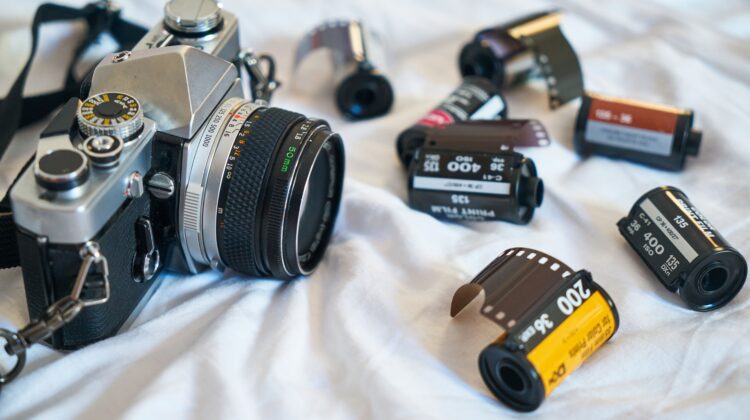
In the early 1970s, the SLR camera market was dominated by massive, heavy, and noisy mechanical monsters. If photographers wanted high-end optical performance, they had to accept carrying around heavy metal bricks that strained their necks during long shoots.
Then came 1972, and Olympus changed the landscape of 35mm film photography forever with the introduction of the Olympus OM 1 (originally launched as the M-1).
Engineered by the legendary industrial designer Yoshihisa Maitani, the Olympus OM 1 shattered industry standards. It reduced camera body size and weight by nearly $35\%$ while simultaneously engineering a larger, brighter viewfinder than its bulky competitors.
It is a fully mechanical masterpiece that operates without needing a battery for the shutter. In this comprehensive Olympus OM 1 review, we will explore its revolutionary design, technical specifications, stand-out features, and why it remains a top choice for modern analog photographers.


Specifications
- • Brand: Olympus
- • Special Feature: Manual Controls, Interchangeable Lenses
- • Film Format Type: 35mm
- • Item dimensions L x W x H: 5.35 x 3.27 x 1.97 inches
- • Included Components: Camera Body & Lens
- • Model Name: OM 1
- • Compatible Devices: Camera
- • Min Shutter Speed: 0.002 seconds
- • Batteries: 1 Lithium-ion battery is required. (included)
- • Viewfinder Magnification: 0.9x
- • Shutter Type: Focal Plane Shutter
Technical Specifications: Compact Engineering Mastery
Despite its ultra-compact foot-print, the internal engineering of the OM 1 is remarkably durable. Here is a breakdown of its core mechanics:
- Camera Type: 35mm Single Lens Reflex (SLR)
- Lens Mount: Olympus OM Mount
- Shutter Type: Mechanically controlled, horizontal-cloth focal-plane shutter
- Shutter Speeds: $1\text{s}$ to $1/1000\text{s}$, plus Bulb (B)
- Exposure Modes: Full Manual Control (with built-in match-needle light meter)
- Exposure Metering: TTL center-weighted open-aperture CdS cell metering
- ISO Range: Manual selection from ISO 25 to 1600
- Power Source: $1.35\text{V}$ PX625 Mercury Battery (used solely for the internal light meter)
- Weight: $510\text{g}$ (Body only exceptionally lightweight)
5 Reasons the Olympus OM 1 Outshines Other Vintage SLRs:
1. Absolute Mechanical Independence
One of the greatest fears when shooting with vintage electronic cameras like the Canon AE-1 or Minolta X-700 is sudden electronic failure or dead batteries leaving you stuck. The Olympus OM 1 features a 100% mechanical shutter mechanism.
The battery inside the camera operates nothing except the small exposure needle in the viewfinder. If your battery dies while hiking, traveling, or shooting on location, every single shutter speed from $1\text{s}$ to $1/1000\text{s}$ will continue to fire with mechanical accuracy.
2. A Massive, Crystal-Clear Viewfinder
When you put your eye up to the viewfinder of the OM 1, you are immediately blown away by its sheer size. Maitani designed an ultra-bright glass prism system that delivers a $0.92\times$ magnification ratio with $95\%$ frame coverage.
It feels noticeably larger and brighter than viewfinders found on larger cameras like the Pentax K1000 or Nikon FM. Framing and manual focusing become an effortless experience, even in low-light environments.
3. Unmatched Ergonomics & Shutter Ring Layout
Olympus completely redesigned traditional camera controls to make the body as small as possible. Instead of placing the shutter speed selector dial on the top plate, they moved it to a concentric ring around the lens mount.
This allows you to adjust your shutter speed, aperture, and focus ring all with your left hand supporting the lens, without ever removing your right hand from the grip or taking your eye away from the viewfinder.
4. Advanced Air-Damped Shutter Mechanism
Miniaturizing a camera usually causes extreme mirror slap vibration, which leads to blurry handheld shots. Olympus solved this by inventing a specialized air-damper system that cushions the mirror's movement as it swings up and down.
Combined with an extraordinarily quiet shutter curtain, the OM 1 allows you to confidently handhold exposures at shutter speeds as low as $1/15\text{s}$ without introducing severe camera shake.
5. Access to Legendary Zuiko Glass
A great camera body is nothing without superior optics, and the Olympus OM Zuiko lens family is world-renowned. Zuiko lenses were engineered with the exact same philosophy as the OM 1 body: ultra-compact dimensions without compromising optical clarity or sharpness.
From ultra-wide primes to blazing-fast portrait lenses, Zuiko glass renders vibrant colors, rich contrast, and signature retro bokeh.
📖 You May Also Like:
Comparing mechanical options? Read our complete breakdown of another all-metal classic: Nikon FE Review: 5 Reasons This Classic SLR Beats the Rest.
Direct Head-to-Head: Olympus OM 1 vs. Pentax K1000
Both of these mechanical cameras are top recommendations for analog photography students. Here is how they stack up side-by-side:
| Feature Comparison | Olympus OM 1 | Pentax K1000 |
|---|---|---|
| Body Weight | 510g (Ultra-lightweight) | 625g (Noticeably heavier) |
| Viewfinder Magnification | 0.92x (Massive & incredibly bright) | 0.88x (Standard brightness) |
| Shutter Speed Controls | Lens Mount Ring System | Traditional Top Plate Dial |
| Self-Timer Included | Yes (Built-in mechanical timer) | No (Completely omitted) |
The Battery Solution: How to Power the OM 1 Light Meter
If you are buying an original Olympus OM 1 today, there is one important technical detail you need to understand regarding its light meter power supply.
The camera was originally designed in 1972 to use a $1.35\text{V}$ PX625 Mercury battery. Because mercury batteries were banned globally due to environmental concerns, modern $1.5\text{V}$ alkaline button cells (like LR44) cause the internal meter to over-read light by approximately $1.5$ to $2$ stops, resulting in underexposed film shots.
3 Easy Ways to Fix the Voltage Issue:
- Use WeinAir MRB625 Zinc-Air Cells: These replacement batteries output an exact $1.35\text{V}$ current without requiring any physical modification to the camera body.
- Use a Voltage-Reducing Adapter: You can purchase a cheap Kanto MR-9 adapter that stepped-down a standard $1.5\text{V}$ silver oxide button cell to $1.35\text{V}$.
- Use Handheld / Smartphone Light Meters: Since the shutter is purely mechanical, you can leave the battery compartment completely empty and use a phone app or hand meter to set your exposure manually!
📖 You May Also Like:
Want a fully automatic electronic alternative? Check out our review of the Canon AE-1 Program Review: The Best 35mm Starter Camera.
Top 3 Lenses for the Olympus OM System
To build a versatile analog shooting rig, start with these stellar Zuiko prime lenses:
1. Olympus Zuiko 50mm f/1.8 (F.Zuiko or Made in Japan)
This is the default standard prime lens, and it is a marvel of optical design. It weighs under $170\text{g}$, features razor-sharp resolution across the frame, and delivers crisp contrast even wide open.
2. Olympus Zuiko 28mm f/2.8
An essential wide-angle lens for street photography, architectural shots, and outdoor landscapes. Its small profile matches the compact aesthetic of the OM 1 perfectly.
3. Olympus Zuiko 135mm f/3.5
An unbelievably compact telephoto portrait lens. Unlike bulky $135\text{mm}$ lenses from other brands, this lens is barely larger than a standard $50\text{mm}$ lens, producing soft blurred backgrounds and outstanding subject isolation.
Complete Your Olympus OM 1 Rig
Set up your classic setup with these essential accessories directly from Amazon:
Gear Up Your Olympus Setup:
-
WeinAir MRB625 1.35V Replacement Cells:
BUDGET PICKStar Rating★★★★★4.8 out of 5 starsOur Score9.8/10Specifications
- • Batteries: 1 Lithium-ion battery is required. (included)
-
Kodak Gold 200 (35mm - 3 Roll Pack):
PREMIUM PICKStar Rating★★★★★5 out of 5 starsOur Score10/10Specifications
- • Brand: Balveli
- • Film Format Type: 135
- • Model Name: Gold 10pk
- • Film Color: Colored
- • Batteries: 1 Lithium-ion battery is required. (included)
- • Exposures per Roll: 36
-
Ilford HP5 Plus 400 ISO (35mm):
TOP PICKStar Rating★★★★★4.7 out of 5 starsOur Score9.7/10Specifications
- • Brand: Ilford
- • Film Format Type: 135
- • Model Name: HP5 Plus
- • Film Color: Black and White
- • Batteries: 1 Lithium-ion battery is required. (included)
- • Exposures per Roll: 36
-
Woven Cotton Retro Camera Strap:
TOP CHOICEStar Rating★★★★★5 out of 5 starsOur Score10/10Specifications
- • Batteries: 1 Lithium-ion battery is required. (included)
Q1: What is the difference between the Olympus OM 1, OM 1 MD, and OM 1N? +
The original OM 1 (1972) had no motor drive support. The OM 1 MD (1074) added support for an external Motor Drive unit (indicated by a small "MD" badge on the front). The OM 1N (1979) added a redesigned flash shoe interface that provides flash readiness LED indicators inside the viewfinder. Mechanically, all three versions are virtually identical.
Q2: Does the shutter work if the camera has no battery installed? +
Yes! The Olympus OM 1 is a completely mechanical camera. The battery is only required to power the built-in light meter. Without a battery, you can select any shutter speed from 1s to 1/1000s and take photos normally using an external light meter or the Sunny 16 rule.


Leave a Reply